Oct 27, 2026
Solids control is often discussed equipment by equipment — the shaker, the desander, the desilter, the centrifuge. That framing is useful for procurement, but it misses how the system actually behaves in the field. The mud returning from the borehole does not arrive sorted by particle size. It arrives as a mixture, and the treatment train must break that mixture down in the right order. This article looks at drilling fluid solids control from the system-design perspective — how stages interact, where the handoffs occur, and why equipment selection has to follow fluid characteristics rather than a product list. KOSUN manufactures solids control equipment for these multi-stage applications.

The Core Premise: Each Stage Inherits the Previous Stage's Output
Drilling fluid solids control is an important part of drilling fluid management, and the reason multi-stage separation exists is simple: no single device handles the full particle-size range in the returning mud.
Shale shakers remove the larger drilled solids. Hydrocyclones address finer particles according to their configuration. Screening adds another cut point where needed. Each unit is designed around a target size band — and each unit performs best when the stage before it has already done its job.
This is the part that gets overlooked. A hydrocyclone fed with oversized cuttings does not separate properly; it plugs or bypasses. A screen fed with solids far above its cut point blinds quickly. The sequence matters as much as the specification sheet.
Why the Feed Keeps Changing
As drilling progresses, the character of the incoming mud shifts. Cuttings volume rises and falls with the formation and the rate of penetration. Particle-size distribution changes as different strata are penetrated. Fluid properties — viscosity, density, solids loading — drift as the mud circulates and picks up material.
A treatment train designed around a single snapshot of conditions will spend much of the project operating outside its intended envelope. This is why equipment selection has to account for the range of conditions the system will actually see, not just the nominal case.
System performance depends on particle-size distribution, mud properties, equipment capacity, and operating conditions — factors that interact rather than act independently.
Hydrocyclones and Screening: Where the Handoff Happens
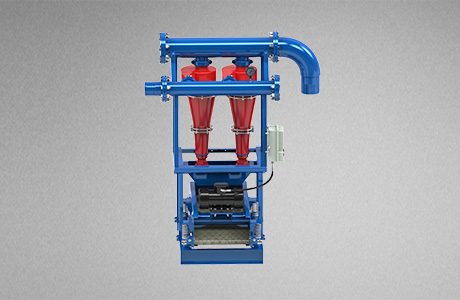
Hydrocyclones generate centrifugal force from fluid flow to separate solids from the liquid phase. Desander and desilter cones are chosen according to what the treatment process requires at that stage.
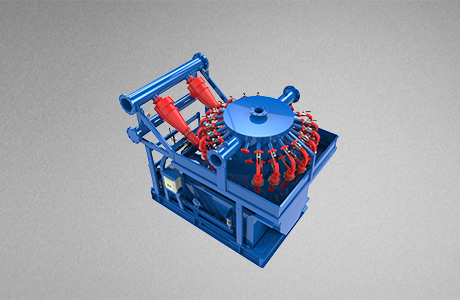
Screening provides a further cut by retaining particles above the selected screen openings. When both are combined in a mud cleaner, the arrangement does something neither can do alone: it processes hydrocyclone underflow and separates cuttings from recoverable drilling fluid.
That combination is typically deployed as secondary or tertiary separation, depending on how the wider system is laid out. The mud cleaner is not a replacement for the other stages — it is the point where cyclonic classification and mechanical screening hand off to each other.
The Weighted Mud Complication
Some operations use weighted mud containing barite to reach the required fluid density. In those systems, every separation decision carries a second cost: recovering reusable weighting material.
A correctly configured mud cleaner can separate larger cuttings while letting recoverable weighted mud pass through the screen. But the recovery figure is not a constant. It depends on mud formulation, particle characteristics, screen selection, and operating conditions.
This is why a fixed recovery rate quoted across different applications should be treated with caution. Equipment selection has to follow the actual drilling fluid, not an assumed average.
Integration: The Constraint Most Often Missed
Effective drilling fluid management requires coordination between individual separation units — and that coordination is where projects most often run into trouble.
Considerations that shape the final configuration:
Required treatment stages: how many cuts the fluid actually needs
Circulation rate: the volume the train must handle continuously
Installation space: particularly on constrained urban or offshore sites
Maintenance access: whether wear parts can be reached without major disassembly
Compatibility with upstream and downstream equipment
A mud cleaner is one element in this chain. Its function is to add separation after initial solids removal — not to substitute for every other treatment unit.
KOSUN manufactures solids control equipment for drilling fluid treatment, including mud cleaners that combine hydrocyclone separation and screening. The practical starting point is understanding the treatment requirements and the characteristics of the incoming fluid; the equipment configuration follows from there.
Conclusion
Drilling fluid solids control works best when approached as a train rather than a catalogue. Each stage inherits what the previous stage delivers, the feed changes continuously as drilling proceeds, and weighted systems add a recovery consideration that unweighted systems do not carry. Getting the sequence and the handoffs right — and matching equipment to the real fluid rather than a nominal figure — is what separates a system that performs from one that merely runs.
KOSUN supplies solids control equipment and technical guidance to support those decisions.